Spore Syringes vs Spore Prints vs Spore Swabs: What’s the Difference?
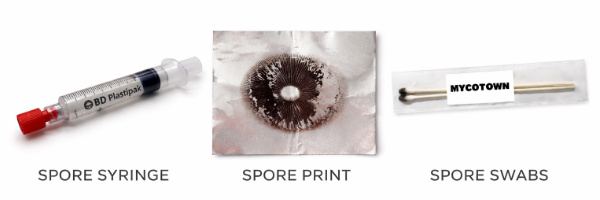
Mushroom spores are commonly preserved and distributed in several different formats, each designed for specific research, educational, and microscopy purposes. Among the most widely discussed formats are spore syringes, spore prints, and spore swabs.
While all three contain mushroom spores, they differ significantly in how spores are collected, stored, handled, and observed. Understanding these differences is essential for anyone studying mycology, fungal taxonomy, or spore morphology.
This guide provides a clear, factual comparison of spore syringes, spore prints, and spore swabs. It explains how each format is produced, what it is typically used for in research contexts, and the key advantages and limitations of each — without providing instructions for cultivation or illegal activity.
What Are Mushroom Spores?
Mushroom spores are microscopic reproductive units produced by fungi. Unlike seeds, spores do not contain stored nutrients and require specific environmental conditions to develop. In mycology, spores are studied to help identify species, understand fungal reproduction, and examine structural characteristics under magnification.
To support study and observation, spores are collected and preserved using different methods – resulting in formats such as syringes, prints, and swabs.
Learn more in:
What Are Mushroom Spores?
What Is a Spore Syringe?
A spore syringe contains mushroom spores suspended in sterile liquid, typically water, inside a sealed syringe.
Key characteristics:
- Spores are evenly dispersed in liquid
- Designed for controlled observation and handling
- Often used in microscopy and educational demonstrations
- Allows consistent sampling
Because spores are already hydrated and mobile, spore syringes are commonly discussed in microscopy contexts where small volumes are examined under magnification.
Advantages:
- Even spore distribution
- Easy to sample consistently
- Minimal handling required
Limitations:
- Liquid environment can degrade over time
- Shorter shelf life compared to dry formats
- More sensitive to temperature changes
What Is a Spore Print?
A spore print is created when a mature mushroom cap releases spores onto a flat surface, typically paper or foil. Once dried, the spores form a visible deposit that reflects spore colour and density.
Spore prints are widely used in mycology for species identification, as spore colour is a key taxonomic feature.
Key characteristics:
- Dry, stable format
- Visible spore mass
- Often stored long-term
Advantages:
- Long shelf life when stored correctly
- Useful for taxonomic comparison
- Minimal degradation over time
Limitations:
- Requires rehydration for microscopy
- Less uniform distribution
- More handling required
What Is a Spore Swab?
A spore swab consists of spores collected onto a sterile cotton or foam tip. The swab is then sealed to prevent contamination.
Spore swabs are commonly used in research settings where surface sampling or targeted spore collection is required.
Key characteristics:
- Dry storage
- Compact and lightweight
- Often used for microscopy preparation
Advantages:
- Long-term stability
- Reduced moisture-related degradation
- Simple storage requirements
Limitations:
- Spores are not evenly distributed
- Requires careful transfer for observation
- Less visually informative than prints
Comparing Spore Syringes, Prints, and Swabs
| Feature | Spore Syringe | Spore Print | Spore Swab |
|---|---|---|---|
| Format | Liquid | Dry deposit | Dry swab |
| Shelf life | Short–medium | Long | Long |
| Microscopy readiness | High | Medium | Medium |
| Storage stability | Moderate | High | High |
| Spore visibility | Microscopic | Visible | Microscopic |
| Handling complexity | Low | Medium | Medium |
Each format serves a different purpose depending on the study context.
Which Spore Format Is Best for Microscopy?
From an educational perspective:
- Spore syringes offer ease of sampling
- Spore prints allow colour comparison
- Spore swabs are useful for controlled transfer
Microscopy use depends on:
- Desired observation method
- Storage duration
- Available equipment
Related guide:
Mushroom Spore Microscopy Basics
Storage Considerations
All spore formats are affected by:
- Temperature
- Moisture
- Light exposure
- Contamination
Dry formats (prints and swabs) generally offer greater long-term stability, while liquid formats are more sensitive to environmental conditions.
Learn more:
Factors That Affect Mushroom Spore Viability
Legal and Ethical Considerations in the UK
In the UK, mushroom spores are legal to possess for microscopy and research purposes, but legality changes if spores are used for cultivation of controlled species.
Readers should always ensure compliance with UK law.
Read more:
Are Mushroom Spores Legal in the UK?
Summary: Choosing the Right Spore Format
There is no single “best” spore format. Instead:
- Spore syringes prioritise ease of observation
- Spore prints support taxonomy and longevity
- Spore swabs balance portability and stability
Understanding these differences allows researchers and students to select the most appropriate format for their educational goals.
Frequently Asked Questions
What is a spore syringe?
A spore syringe is a sterile syringe containing mushroom spores suspended in distilled water. It is commonly used for microscopy and research due to its convenience and ease of handling.
What is a spore print?
A spore print is a collection of mushroom spores deposited onto a sterile surface, usually foil or paper. Spore prints are valued for their long-term storage potential and purity.
What is a spore swab?
A spore swab consists of spores collected on a sterile cotton or foam swab. Swabs are often used when spores need to be sampled from specific areas or for detailed microscopic examination.
What is the main difference between spore syringes, prints, and swabs?
The main difference lies in format and handling:
- Spore syringes contain spores in liquid form
- Spore prints store spores in dry form
- Spore swabs collect spores on a sterile applicator
Each format has different storage, handling, and longevity characteristics.
Are spore syringes better than spore prints?
Not necessarily. Each format serves different research and observational purposes.
Do spore prints last longer than syringes?
Yes. Dry formats generally have a longer shelf life.
Are spore swabs better for storage?
Spore swabs are stable and compact but require careful handling for observation.
Which spore format is best for beginners?
Spore syringes are often preferred by beginners due to their ease of storage, transport, and use under a microscope.
Which spore format lasts the longest?
Spore prints generally have the longest shelf life when stored correctly in cool, dry conditions, often remaining viable for several years.
Are spore syringes, prints, and swabs stored differently?
Yes.
- Spore syringes are best stored refrigerated
- Spore prints and swabs should be kept dry, dark, and airtight
Proper storage is essential for preserving viability.
Are spore swabs better than spore prints?
Neither is universally better. Spore swabs offer precise sampling, while spore prints are better for long-term storage and archiving.
Do spore syringes contain live material?
Spore syringes contain microscopic spores suspended in sterile water. They do not contain active growth and are intended for microscopy and research purposes.
Which spore format is best for microscopy?
All three formats are suitable for microscopy. Spore syringes offer convenience, while prints and swabs allow for controlled sample preparation.
Can different spore formats be stored together?
Yes, as long as each sample is individually sealed to prevent moisture exposure or cross-contamination.
Why do some people choose spore prints over syringes?
Spore prints are often chosen for:
- Long-term storage
- Archival purposes
- Reduced moisture exposure
Why do some people prefer spore swabs?
Spore swabs are useful for:
- Targeted sampling
- Reduced contamination risk
- Minimal moisture exposure
Can all three be used for microscopy?
Yes, though preparation methods differ.
Are there legal differences between spore syringes, prints, and swabs?
Legal status depends on location and species. In the UK, spores themselves are legal to possess for microscopy and research purposes. Always check current local regulations.
Which spore format should I choose?
The best choice depends on:
- Storage needs
- Intended research use
- Personal preference
Each format has advantages and limitations.

Written by Mycotown Editorial Team
The Mycotown Editorial Team is responsible for producing and reviewing educational and reference content across the site. Our focus is on accurate, responsible information relating to mushroom spores, microscopy, and lawful research practices. View author profile