How to Store Mushroom Spores
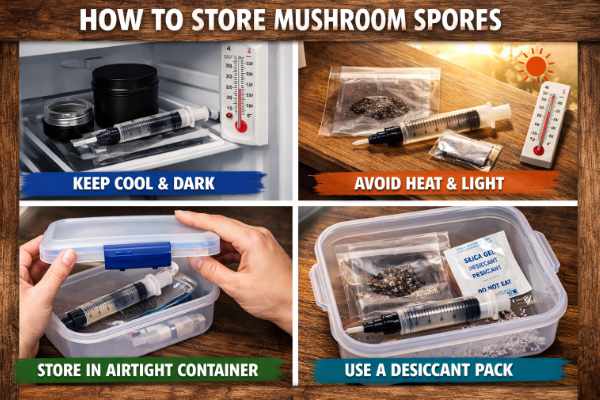
Proper storage is essential when handling mushroom spores.
Whether spores are being kept for microscopy, research, or educational study, correct storage helps preserve their condition, prevents contamination, and ensures responsible handling.
This guide explains how mushroom spores are typically stored, what affects their longevity, and how to handle them safely and ethically in the UK.
Why proper storage matters
Correct storage helps to:
- Maintain spore condition over time
- Reduce contamination risk
- Support accurate microscopy
- Demonstrate responsible handling
Poor storage can lead to degradation, contamination, or reduced usefulness for study.
Factors that affect spore longevity
Several variables influence how long spores remain viable and suitable for microscopy:
Temperature
- Cool, stable temperatures are preferred
- Avoid heat exposure
Light
- Prolonged light exposure may degrade spores
- Store in dark or opaque containers
Moisture
- Excess moisture increases contamination risk
- Storage containers should be sealed and dry
Handling
- Frequent handling increases contamination risk
- Use sterile tools when applicable
Storage methods by spore format
How should spore prints be stored?
Spore prints should be stored:
- With a desiccant packet to control moisture
- Fully dried
- Inside sterile foil or envelopes
- Sealed in an airtight container
How should spore syringes be stored?
Spore syringes should be:
- Protected from light and temperature fluctuations
- Kept sealed with a sterile cap
- Stored horizontally or vertically inside an airtight container
- Refrigerated when possible
How should spore swabs be stored?
Spore swabs are usually stored:
- Fully dry before storage
- In sterile packaging
- Stored in a cool,dark, dry place
- Protected from humidity and handling
Proper storage helps reduce contamination risk.
Shelf life: how long do spores last?
There is no single shelf-life rule.
Longevity depends on:
- Species
- Storage method
- Environmental conditions
- Initial quality
When stored correctly, many spores remain suitable for microscopy for months or longer.
When stored correctly, mushroom spores can remain viable for:
- Spore syringes: 6–12 months (sometimes longer)
- Spore prints: Several years
- Spore swabs: 1–2 years or more
Do mushroom spores go bad?
Yes. Spores can lose viability over time due to:
- Heat
- Light exposure
- Moisture
- Poor sealing or contamination
Proper storage greatly slows this process.
Legal and ethical considerations
While mushroom spores are legal to possess in the UK, responsible handling remains essential.
Storage should:
- Align with lawful, educational use
- Avoid misuse
- Follow current UK law
For a detailed explanation of legality, see:
Are Mushroom Spores Legal in the UK?
Frequently asked questions
How should mushroom spores be stored?
Mushroom spores should be stored in a cool, dark, dry environment, ideally inside an airtight container. Keeping spores away from heat, light, and moisture helps preserve their long-term viability for microscopy and research purposes.
What is the best temperature for storing mushroom spores?
The ideal temperature range for storing mushroom spores is 2–8°C, such as in a refrigerator. This slows biological degradation and helps spores remain viable for longer periods.
Should mushroom spores be stored in the fridge?
Yes, refrigeration is commonly recommended for long-term storage. Spores should be sealed in an airtight container before being placed in the fridge to prevent moisture exposure and contamination.
Can mushroom spores be stored at room temperature?
Mushroom spores can be stored at room temperature for short periods, but this may reduce their longevity. For best results, cool storage is preferred, especially if spores are not being used soon.
Do mushroom spores need to be stored in the dark?
Yes. Exposure to light, especially direct sunlight or UV light, can degrade spores over time. Dark storage helps preserve spore integrity.
Can old mushroom spores still be viable?
In some cases, yes. Well-stored spores may remain viable long after their expected lifespan, though success rates may decline over time.
Why is moisture bad for mushroom spores?
Moisture can promote contamination, cause premature degradation and reduce spore viability. Keeping spores dry is one of the most important storage principles.
Should I use desiccant when storing spores?
Yes. A silica gel desiccant packet helps absorb excess moisture and is especially recommended for spore prints and long-term storage.
Can mushroom spores become contaminated during storage?
Yes, contamination can occur if spores are exposed to air, moisture and unsterile surfaces. Using airtight containers and minimizing handling reduces this risk.
Should mushroom spores be handled with gloves?
Using gloves is recommended when handling spores to reduce contamination and avoid introducing oils or moisture from the skin.
Can mushroom spores be frozen?
Freezing is not generally recommended. Ice crystal formation and condensation during thawing can damage spores and reduce viability.
Should mushroom spores be shaken during storage?
No. Spore syringes should be left undisturbed during storage. Excessive agitation is unnecessary and may affect long-term stability.
What container is best for storing mushroom spores?
Airtight plastic containers or sealed bags placed inside a storage box are ideal. Containers should be clean, dry, and clearly labelled.
Should mushroom spores be labelled during storage?
Yes. Labels help track species or strain, storage date and storage format. This is especially useful for long-term collections.
Can I store different spores together?
Yes, as long as each sample is individually sealed to prevent cross-contamination.
Final thoughts
Proper storage is part of responsible mycology practice. By understanding how spores are affected by environmental conditions, you can handle them safely, ethically, and in line with UK regulations.
Related learning resources

Written by Mycotown Editorial Team
The Mycotown Editorial Team is responsible for producing and reviewing educational and reference content across the site. Our focus is on accurate, responsible information relating to mushroom spores, microscopy, and lawful research practices. View author profile